

Few dishes carry a country on their shoulders the way khinkali carries Georgia. A pleated purse of dough, a knot of spiced meat, and — the part that surprises first-time eaters — a spoonful of hot broth sealed inside. It is a dish built for sharing, and it comes with its own etiquette.
Born in the mountains
Khinkali is generally traced to the mountain regions of eastern Georgia, Pshavi, Mtiulet and Khevsureti, where a filling dish that travelled well suited a herding life. The mountain original was plain: lamb, salt, and not much else. As it moved down into the towns and eventually into Tbilisi, the filling picked up onion, chilli, coriander and cumin, and beef and pork joined the lamb.
The pleats are the point
The twisted top of a khinkali is not decoration. Each pleat is a fold worked by hand, and cooks are quietly judged on how many they can lay down evenly — a well-made dumpling is often said to want nineteen or more. That thick topknot has a job: it is a handle, and it is also the part you are not supposed to eat.
How to eat one
Pick it up by the topknot. Turn it upside down, bite a small opening in the side, and drink the broth before you eat anything else. Then work through the meat and dough, and set the little grey knot down on the side of your plate. At a table of friends the knots pile up, and they are the running tally of who ate what.
Black pepper is the only seasoning that belongs on the table. No sauce, no fork — a fork punctures the dumpling and the broth is gone before it reaches you.
Where to find it on our menu
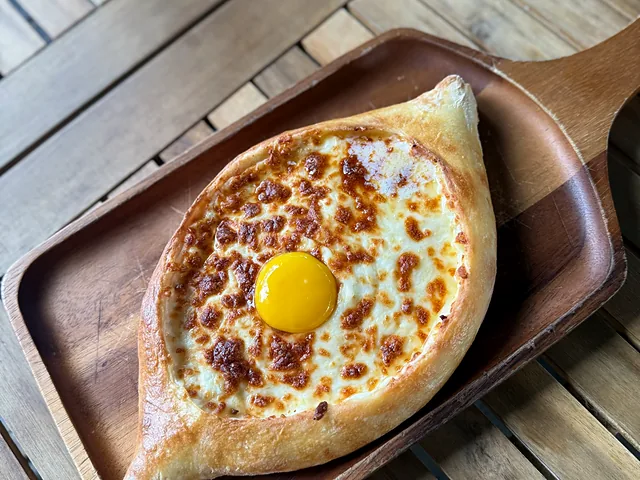
We serve khinkali both boiled and fried: the boiled version is the classic, filo-pleated dough filled with spiced ground meat and savoury broth, served hot with black pepper; the fried version trades the broth for a crisp shell. They sit alongside the other Georgian dishes on the menu, including Khachapuri Adjaruli — the cheese bread with an egg yolk set into its centre.