

Central Asian cooking is the food of a crossroads. Caravans crossed these steppes and oases for centuries, and every one of them left something behind — rice from the south, noodles from the east, bread ovens from the west, and a whole vocabulary of spice.
Rice, in a wide iron pot
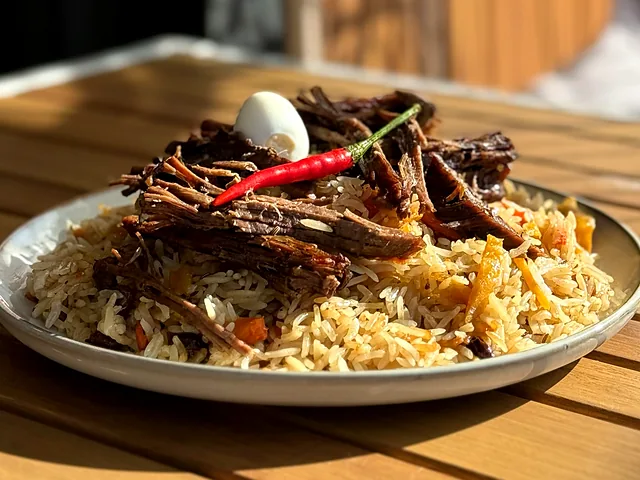
Plov, or pilaf, is the region's centrepiece. It is cooked in a kazan, a heavy round-bottomed pot set over fire, and it is cooked in layers rather than stirred: meat first, then onion, then carrot cut into long batons, then rice smoothed flat on top so the steam does the rest. Ours is made with beef and lamb, long-grain rice, yellow carrots, chickpeas, raisins, olive oil, onion, garlic and seasonings.
Yellow carrot matters here. It is drier and less sweet than the orange kind, and it holds its shape through a long cook instead of dissolving into the rice.
Noodles pulled by hand
Lagman came west along the same roads. The dough is rolled into a rope, then stretched, doubled, and stretched again until a single piece becomes a nest of noodles — a technique shared with the hand-pulled noodle traditions further east. It arrives in a broth built on lamb, garlic, onions, carrots, bell peppers, cumin and paprika, and it is somewhere between a soup and a stew depending on who is serving it.
Bread and the pastry family
Nearly every meal is anchored by bread baked against the wall of a clay oven, and by the pastries that share its heat. Samsa is the best known: a baked parcel of dough with a savoury filling, in our case rib-eye beef and onions, finished with sesame seeds. Its fried cousin, the cheburek, is thinner, crisper and filled with seasoned ground meat and onions.
What ties it together
For all the variety, the logic is consistent: slow heat, few but confident spices — cumin, coriander, paprika, black pepper — and dishes sized for a table rather than a plate. It is food that assumes company.